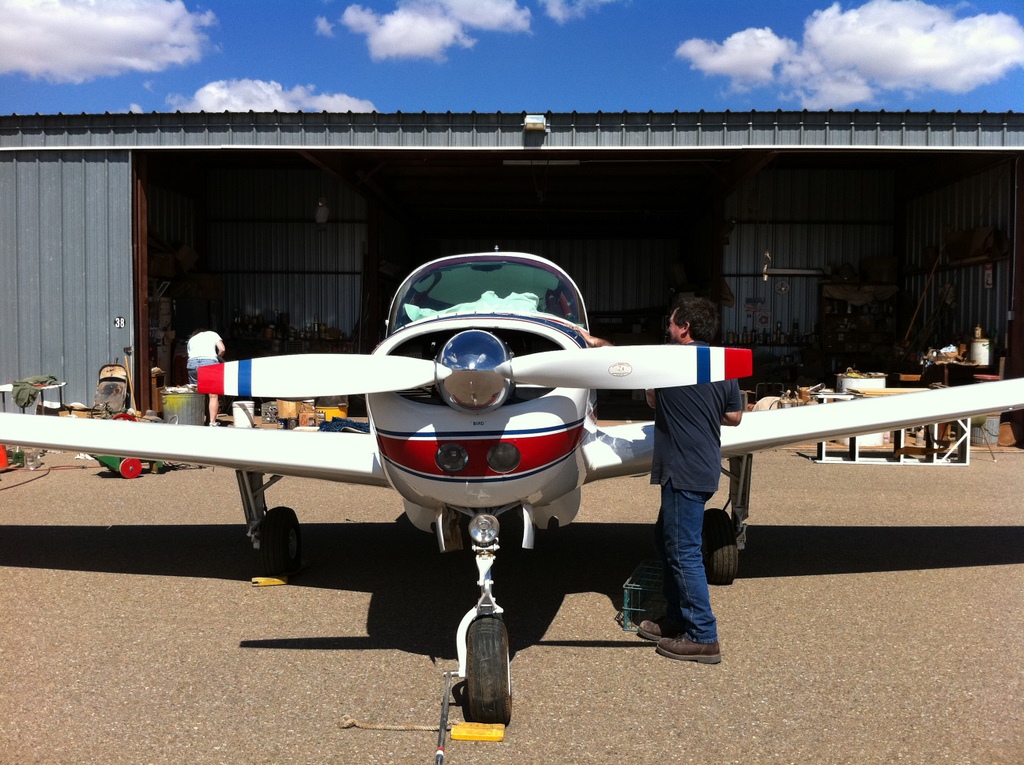
On the joy of flight.

If I were going to guess, I’d probably say that most pilots don’t really remember what it’s like not being a pilot. Many of us take for granted what it takes to keep a plane flying straight and level. We may even lose the sense of awe we felt at the onset of training, that someone would actually let us take the controls of an airplane.

I’ve been reminded twice in the last few months how amazing these flights can be.

Several months ago, I took two co-workers on a flight down to Pismo Beach to ride ATVs. I put on my pseudo-instructor hat, leveraging the hours I’d spent with all of my own instructors, and walked them through the pre-flight, described the phases of flight, and then let them participate by calling out the checklists.

Each took a turn in the right seat, sorting out the “Death Grip”, understanding wings level, and developing a sense for climbing and descending. It just makes me tingle as I watch this process, because it does remind you of those things you take for granted when you fly.

The jewel of that flight, the moment I won’t soon forget, happened when were returning. The guys had switched seats. The co-pilot had the controls, and I was calmly making the occasional suggestion about where we should be headed, vs where we were actually headed. Then, out of nowhere, from the backseat:

“Man, this view is AMAZING. I mean, you can see everything from up here. I don’t think anyone can actually say they’ve really seen California unless they’ve seen it from a small plane. This is so cool!”

There are those who would say that I went a little overboard bringing the plane back, but in that moment, I was feeling pretty good about all of the decisions I’d made.

The most recent reminder came as I ferried the bird from Palo Alto to her new hangar at San Jose. A friend of mine was visiting from out of town, and I’d offered a ride long ago, so I asked her of she’d like to come along. We’d head for the coast, fly down over Watsonville, past South Country, and then beeline it back to San Jose.

Same drill on the pre-flight and briefing. She listened quietly, but intently. On the climb out, my mike button started sticking, so I’d have her push hers and then tell her what to say on the intercom.

Aside from a bit of a flinch right at the beginning (“Wait, you want me to what?”), she pretty much nailed it. Before long, she was the one flying, and I’d cover the radio as appropriate (as the stuck mike issue had subsided). First with two hands, eventually with one. I let her try to intuit turns before discussing the need for a little elevator in the turn. She picked up pretty much instantly (though any turn that gave any sense of g-force I think gave her the sensation she was going to break the plane).

After we dropped off the plane, and as we were driving back to Palo Alto to pick up the car we’d left there, we debriefed the flight.

I found myself desperately trying to demystify some of the rules, as well as the radio communication. I was impressed by the fact that she had been able to recall some of the instructions we’d been given (Hold Short, Line Up and Wait, or Decend and Maintain) and that she had internalized the motivations for these requests. It made me reflect on my own lack of retention for some of these items in the beginning.

These flights are just a fascinating process to watch, and in some small way makes you feel like you’ve payed forward a bit of the time other pilots had spent with you when you were discovering flight.

In the Meyers, I suppose I’m up to three “Pilot Experience Flights”. I think I’d only had three or four before that.

Given the value to these would-be pilots, and the education that I get from each experience, clearly, I need to set a higher goal.

Posted in Uncategorized | 3 Comments

An unexpected gift…

After several years of restoring the plane, the prospect of flying her across the country to attend the 2013 Meyers Owners Association fly-in in Tecumseh, MI was daunting. Thankfully, Mark Erwin joined me on the adventure, and the two of us struck out across California, Nevada, South Dakota and states west to finally arrive at her birthplace. The trip was full of emotion for me.

It was to be my final flight test to qualify for solo flight of the plane, bringing to reality a childhood dream. And it was also an opportunity to meet others who had also given a part of themselves to carry on the legacy of ownership of the Meyers design.

IMG_4215

However, the most important gift I found waiting for me in the middle of Michigan was the opportunity to put a face to a gravelly voice that had helped to guide the work that brought the plane back to life. On the last day of that fly-in, I stood beside this crusty relic of a man, largely confined to an electric scooter, and confided what I had cost me, and my worry that my dad might have been a little disappointed in some of the decisions I’d made.

This man, Keith Diver, took a deep, wheezing breath, and spoke with a gentleness that caught me a little off guard. “Mark,” he said, “I knew your dad, and I’m very aware of the relationship you two had, but I can tell you…” He paused. “I can tell you because your dad was a friend of mine.” He paused again and turned away. “Your dad would have been proud.”

I turned away as well. I hadn’t flown half way across the country to find it, but in that moment I felt closer to my dad than I had in years. I wiped the memories from my eyes, and turned to see Keith doing the same. The return flight beckoned, and daylight was waning. I shook Keith’s hand, and thanked him for the thought and all the work he’d done on my plane. I told him that I’d take good care of that plane. He looked up at me and said, “Well, you damn well better,” and then wheeled himself away.

I didn’t know it at the time, but as the plane lifted off and I wagged the wings to say goodbye, it would be the last time I’d see Keith, waving from in front of the hangar.

IMG_4223

Keith Diver passed away April 22, 2014. Blue skies and safe travels Keith.

Posted in Uncategorized | Leave a comment

Low Pass, Meyers Diver’s Field, Tecumseh, MI

I’m in the process of writing a trip report from my recent cross country flight back to Meyers-Diver’s Field in Michigan, DuPage, WI, Columbus, OH, and Oshkosh, WI.   Until it’s finished, thought people might appreciate this video of 1JR making a low pass at the owner’s fly-in.

Low Pass

Posted in Uncategorized | 1 Comment

After so many years…

Finally, after a lot of hard work, N111Jr takes to the skies on a test flight.

Test flight #1 was uneventful, lasting a mere 15 or so minutes.  A few adjustments to be made before the next flight, including a little additional work on the gear struts.     In this flight, the gear remained down in flight.

The next flight is scheduled for early next week.

For your listening pleasure (better video during the next flight hopefully):

https://www.youtube.com/watch?v=p3-NJCXEgPk

Posted in Uncategorized | Leave a comment

Someday, I’m going to be a pilot…

This past weekend, I spent another two days in Clovis, NM.   In spite of our best efforts to recycle many of my father’s possessions into the hands of family and friends, there were many items left over.    My sister had decided that the best approach for the rest of his material goods was to sort through what was left, set up a bunch of tables, and then open the doors to the public.

While I was away from the house Thursday evening, someone had come to the door and spoken with my sister.  This  fellow had seen the advertisement for the “estate sale” in the newspaper had come a day early to get a look at what was available.  She politely turned him away, noting that we were still sorting through everything, but not before he offered to come in and help with the sorting.  Seemed like a nice enough fellow, but we had enough hands and it was good for the four of us (my sister Margaret, her husband Greg, and my niece Megan) to have some time alone to sift through the remaining material evidence of my father’s life.  Personally, I also didn’t want anyone looking at all my father’s possessions until we’d had a time to eliminate some of it that nobody would want.

I was a little surprised by the volume of what was left.  I suppose when we last left I was so eager to be done that I just hadn’t taken a look back.  We moved small items from each of the three rooms out into the two front rooms of the house.  One of the rooms would be cleared completely and marked as off limits to visitors.   This would give us a place to protect items we found during the process that we might decide we wanted to keep.

I took home a few things on the last trip to Clovis and I honestly couldn’t believe there would be anything else left in the house that would appeal to any of us.

As the sorting process progressed, I was surprised to find small items that had been overlooked on the first pass that represented sometimes small connections the time I’d spent with my father.    Most notable were:

  • A large bag of patches he’d accumulated from his flying career, of which I remembered his flight suit name badge, several squadron his bars, and his 100 missions patch from vietnam.
  • A bronze plaque engraved with the poem high flight (my aunt and uncle also valued this poem, sending me a copy when I earned my private pilot’s licence).
  • A small coffee mug with the emblem of one of his fighter squadrons (an ace of spades with run through with a sabre)

We were exhausted that evening when we finally called it a night.  We stopped for dinner, and made it back to the hotel by 8pm.   Although I tried desperately hard to postpone passing out, I gave in by 9pm.

The next morning, we managed to make it back to the house by 7:10am, only to find the same fellow who’d offered to help the night before waiting near his car smoking a pipe.   He knew that the published start time wasn’t until 8am, but he offered again to help use finish preparations which we again declined.   It seemed strange to me that this guy was so eager.

At about 7:40, my brother-in-law went outside and found a small crowd forming waiting for the 8am start time.   After telling them to head on in, the carnage began.  At least eight people started picking through the goods laid out on the tables and floor and immediately started asking “What do you want for this?”

At first I deferred all questions on price to my sister.   Some part of me didn’t want to be responsible for setting a price on my fathers things, and I figured that he’d be more inclined to forgive her.   My father was disinclined to get rid of anything, having a great insight into the potential value of even the most mundane things.   He was what some might call a collector, that others might call a hoarder.   I suppose it truly depends upon your vision.

Eventually I gave in, largely because I began to see the tax it was putting on Margaret, and at least partially because, for some items, she’d turn to me and ask.   It was a fascinating experience.   Not wanting to undervalue something, I’d toss out a price of, say, ten dollars, imagining that I would be countered.  More often that not, they would just hand me ten dollars and keep digging.  At some point, Greg asserted that assigning small items individual prices just wasn’t time efficient, so he started having people make piles which he would price in bulk.

There were two things I found interesting about the people who showed up.  First was that there seemed to be a core group of people who were well acquainted with each other.   They greeted each other by name, and lauded each other for their finds.  These, I determined, were the “professionals”.    Some had specialties, while others seemed to be collecting anything of value that they figured they could turn for a profit.   Some part of me was a little offended by this until I realized this was their business and they were doing me a favor, saving me from having to haul everything off myself.

The second thing was there were people there would buy ANYTHING that wasn’t nailed down.   My sister, the night before, had put a stop to my attempt throw out food stuffs that were stacked on the shelves.  “Someone,” she said, “will be willing to sort through and find the food that hasn’t passed the expiration date.”   I was skeptical until a small family stopped by and asked if the food was for sale.  We noted that that some was at or past the expiration date.   They understood, and again asked what we would want for everything.   Margi suggested a few dollars, which they quickly accepted before packing up the lot.

Someone else emptied the silverware drawer, another bought all of the plates and bowls, while someone else snatched up virtually every extension cord in house (and let me tell you, my father was fond of extension cords).

My father had owned four vehicles, one of which had already made the trip back to Kansas with my brother-in-law.   Remaining were a Corvair, a green Blazer, and an old motor scooter (in a million parts).   Greg managed to find buyers for the Corvair and the scooter, and we had just loaded the Blazer on a trailer for Greg to take back to Kansas when someone who’d earlier offered to buy it came back with an upgraded offer.   Greg summarily refused (largely because he’d already loaded and unloaded that Blazer five times).   It was inspiring to see Greg deal with the people who wanted to buy the cars and some random tools.   It is an art and Greg is an accomplished artist.

This whole process went on for the better part of two days.  At some point, in the middle of the second day, Jaime (my father’s gardener and friend) stopped by with his son to see how things were going.  They ended up staying the rest of the day to help out.

It was near the end of the day when I decided I needed to take one more trip out to the hangar to drop off some avionics I’d found that needed to be put back into the plane.  I asked Jaime if he and his son would like to get a look at the plane, as we’d missed the opportunity the last time I was visiting.   His son, an energetic 10 year old, seemed delighted at the chance to see the plane.

On the drive out, he quizzed me about “the colonel” which I came to understand was how both he and his father referred to my father.   “What did he fly?”  “Did he fly jets?”  “Is it harder to fly a jet?”   “Could I learn to fly a plane?”  “Could I fly a jet someday?”    He was dumbfounded when I told him that my father hand let me have the controls to the plane when I was ten years old.

When we arrived at the airport, I let him unlock the hangar and push the hangar door back, as I done when I was a boy.  For me, that “chore” was a high light of every trip.   As he pushed on the hangar door his attention turned toward the plane and his face lit up.

His responsibility for this trip to the airport was to remind me to put the avionics into the baggage compartment, which he did (since I forgot, as I was so excited for him to see the plane).   Afterward, I reached up and unlatched the cabin door, then invited him to climb up onto the wing and take a seat.

It’s embarrassing to admit, but I could feel tears welling up in my eyes at that moment.   He’d never been in a plane before and I could see the thrill in his face as I told him to take hold of the yoke.   In the minutes that followed, he received his first 15 minutes of ground instruction.    He turned the yoke and was awestruck by the fact that he was moving the control surfaces.   As he pulled back, he turned and looked over his right shoulder to see the elevator lift.

I told him to sit up on his feet so that he could get a good look over the panel.   “What do you see?” I asked him.  I can see the car and the hangar,” he replied.   “No,” I told him, “What you see is the runway out in front of you.  You’re at the end, and you’re about to take off.  Are you ready?…I’ll be the engine.”

I started making mock engine noises as the plane began rolling down the imaginary runway.   “Hold it down.  Don’t pull back yet, we have to pick up some speed,” I told him.   “OK, let me know when we’re going fast enough,” he responded.

When I told him to begin pulling back, he did so smoothly and then held the yoke back.  “We’re in the air,” he said, before slowly beginning a right 45 departure.  He was elated.   He asked about all of the instruments and random other objects my dad had spread around the cockpit.   He was learning fast.

After closing up the hangar, we started to pull away in the car and I saw one of the commuter turboprops landing.   From the vantage point at the end of the row of hangars, we had a perfect view of his turns to base and final, then his touchdown and taxi.   More questions followed as I pulled through the security gates.

Then it hit me.  The icing on the cake.   I asked if he wanted to go into the terminal building for a closer look at the plane that had just landed.   “You bet!”  he responded.

When inside, I quietly asked the counter agent if this was a quick turn for the commuter, and he told me that the plane was staying for the night.   I followed up asking him if he’d consider asking the pilots if a ten year old who’d just sat in a plane for the first time could possible come out to take a look at a slightly larger cockpit.

In today’s world of terrorism and increased security, it’s nice to know that there are still opportunities, at small airports, and with the help of normal everyday people, to make little kids feel special.   The counter agent was a great guy to ask, and the pilots were equally as nice to agree.    Jaime’s son was overwhelmed.   He said “Thank you sir” and was so polite and well behaved that I think even “the colonel” would have been impressed.

On the ride back, I was asked if I would come back sometime and take him for a flight.   I explained that I have a bit of a journey ahead of me to learn enough to fly the Meyers, and that the Meyers has it’s own journey as well, but that when I was ready, and the plane was ready, that I’d take him up, and I’d turn the plane over to him.

“Dad,” he said, “I’m going to be a pilot, and you’re going to have to sit in the back seat.”   Jaime smiled.

I imagine my dad was smiling as well.

Posted in Uncategorized | 2 Comments

Going it alone…

I flew last a couple of weeks ago.   My instructor suggested hopping around the bay doing landings at each of a few local airports.  We stopped at Oakland, Livermore, and San Jose, before returning back to Palo Alto.  It was with no small amount of reservation that I agreed.

I was worried a number of things: flying in the complex airspace of the silicon valley, the controllers who would surely realize that I was a returning pilot, the constant frequency changes since the airports seemed so close together, and the art of picking up ATIS, listening for communication directed at me, and flying the airplane (though I suppose I should have listed those three in the opposite order).

As a credit to my instructor, he prepared me before we left, gave me subtle reminders during the flight (for example, saying “almost there” as I was approaching a target altitude), and managed the GPS to make sure I had all of the frequencies at my fingertips at all times.   Everything just seemed to start to fall into place.   I realized, inbound to Oakland, that I was experiencing a joy that I had denied myself for far too many years.

The Cessna 172 was flying gracefully, the weather was perfect, and the controllers were clear, helpful, and accommodating.   In fact, the only hitch in the plan was a bit of a miscommunication with San Jose when I was handed off to the tower.

As if on cue, the tower controller handed me an instruction that just didn’t make any sense.  I looked at my instructor,  and he looked back at me and shrugged as if saying, it doesn’t make any sense to me either.   If there was one thing I remember from my previous training, it’s that in flying, it’s better to open your mouth and let someone think you’re a fool, than to keep it closed and remove all doubt.

I asked for a clarification, and the response was a perfect combination of impatience, contempt, and frustration.  He repeated the same instruction, a little quicker, with a touch of anger in his voice, “No, 4-Sierra-Papa, listen, I said fly direct, left base, for runway 3-0…”, and then stopped abruptly.   He paused.

Then came the words I’d hoped to hear: “4-Sierra-Papa, correction, fly direct, RIGHT base, runway 3-0, cleared for the option, caution the wake turbulence.”

It was as if the gods of flight decided to test my willingness to question the voice on the other end of the line who is, so often, always right.   It was another small experience, of many each flight, that reminds me to remain vigilant and constantly question where I am and what I’m doing.

The flight ended back at Palo Alto, though for the life of me, I have almost no recollection of the landing.  My second flight back, and we’d had a gorgeous day for it.   For a couple of hours, all of the other stressors of life had faded into the background.

As we walked back into the club, I honestly thought that if I had a few more flights that went as well as that day, my instructor might actually turn me loose in a plane on my own.

I was in no great rush, mind you.  Every day seemed to be filled with new flying facts that streamed back into my mind.   I would wait as long as necessary to make myself and my instructor confident in my ability to fly an aircraft.

Then he said it.   “So much is coming back to you, so fast.  You’ve clearly demonstrated the skills and knowledge you need to fly an airplane.  If we can finish off the ground requirements for your BFR and the club requirements for Solo, I might just have to let you do a turn or two around the pattern on your own.”

My heart raced.  A sense of joy rushed over me (followed almost immediately by a sense of fear).   All I could manage to get to come out of my mouth was “Well, we’ll see how things go on the next flight.”

Two weeks later, the afternoon of October 31, I show up three hours early for my lesson.  After staking out my claim to one of the tables in the club, I set about clearing up the remaining paperwork.   I answered the questions I knew, look up all those that didn’t leap immediately to mind, and starred for review those that didn’t seem to be right even after I’d looked them up.   As a testament to the integrity of the club, the questions were extensive, covering a lot of material.   What might have seemed at the outset like a tedious task was instead fascinating as I poured over the FAR (Federal Aviation Regulations), AIM (Airmen’s Information Manual), sectional maps, and the POH (pilot’s operating manual) for the plane.

When Mark arrived, I’m sure he was amused to see me spread out all over the table in the break room.   We moved to the conference room and reviewed all of the paperwork, before settling in to discussion about the day’s route of flight.  We decided that a trip from Palo Alto to Tracy would provide more context on getting out of the airport to the east, as well as set us up at a quiet, remote airfield for a possible solo if things went well.

I headed out to the airplane to begin my pre-flight inspection.

The pre-flight inspection is systematic walk around the plane that allows a pilot to verify that all the required pieces are still attached to the plane.   I’ve always enjoyed the Zen aspect of this part of the flight.   I try not to rush, and I always make an effort to look for anything that might be new or might have been missed on previous pre-flights.   I’m sure it sounds strange, but I also really like putting my hands onto the plane.   It connects you to the machine, in much the same way as stroking the neck of a horse before you ride it.

With the pre-flight out of the way, we started the engine and headed out across the bay towards Hayward, Livermore, and on to Tracy.

The weather was perfect for flying.  Cool, light winds, and CAVU (Ceiling And Visibility Unlimited).   In what seemed like only a few minutes we were beginning our approach into Tracy.   It had been so long since I’d approached a non-tower airport, I asked if I could perform an overflight to check the wind indicator, look for traffic, and just get a general picture of the airport.  We’d picked up the broadcast of the Automated Weather Observation System (AWOS) and monitored the Common Traffic Advisory Frequency (CTAF) of the airport on the flight in.   There appeared to be no other planes active at the airport.

Approaching for the overflight, we noticed a small plan in the run-up area preparing for takeoff.   As I flew overhead, I kept an eye on him and continued to broadcast my position overhead.   The wind direction indicator below was hinting at variable calm.

A minute later, this small plane taxied onto the runway and silently took off without a peep.    Circling back to enter the traffic pattern for the active runway, I continued to watch this fellow as he departed on the upwind leg and I joined the downwind leg.  With the minor exception of some slightly aerobatic turns in the pattern (and some corresponding gasps from my instructor), the landing was absolutely, without a doubt, one of the most perfect I’d ever executed.  I hardly knew the tires were on the ground.

We taxied back to the active runway for one more landing, this time without the benefit of flaps.   I expected the sensation of more speed to be a little disconcerting, but the plane just flew itself down again and settled in for a smooth (though somewhat more prolonged) flare and touchdown.

At this point, confident that I wouldn’t put any new decorations on the plane, my instructor declared “I think you’re ready.  Pull up into the parking area so that I can get out.”

I remember the first time I soloed an airplane.   My instructor, Luther, climbed out of the Cessna 152 and told me good luck.   The tower controllers at the Huntsville International Airport had little else to do that afternoon.  One of them chimed in on frequency with, “Just fly it the same as you did on the last landing, and you’ll be fine.”  I taxied out to the end  of runway 36 right, and stared down the centerline of a runway ten thousand feet long.     I pushed the throttle forward and that little plane launched off the runway like it was being compelled to fly with jet assist.   I flew three turns around the pattern with a white knuckle grip on the yoke, and had to remind myself to breath every once in a while.  It was at the same time both exhilarating and terrifying.   I wanted to fly, but more than anything else, I wanted to finish.   The sense of accomplishment was amazing, but it was nothing compared to the sense of relief that it was done.

Now, years later, (and for those keeping track, my third solo), while I was a little nervous, I was more concerned because I knew I would be self critical of every deviation from what I had been taught.   This time, I sought perfection.

Taxiing back out onto the runway, I was calm as I pushed the throttle forward.   The response from the engine was immediate, the propeller pulling the plane into a quick ground roll.    I smiled and a rush of wonder and excitement came over me.  It had been so many years since I last found myself in a plane alone.   I watched the speed build, the ground rushing by, and hardly even had an opportunity to pull back on the yoke before the plane was off the ground, climbing away from the runway.

I wish I could write that the next four landings were as perfect as the first, but they weren’t.   I had to extend a downwind and lost the rhythm of my checklist for landing.  I ended up high, had to slip it down, and then ballooned in ground effect a little before touching down.   As I taxied back, I opened the side window and leaned the mixture a bit, then waved to my instructor before taking the runway again.  it wasn’t until I pulled out onto the runway that I realized the window was still open and the mixture was still set to lean for taxi, instead of rich for takeoff.    I cleaned things up and flew around again for a touch and go.   After touching down,  I applied full throttle, popped up in a second, then retracted every bit of  the flaps that were providing all  that wonderful lift.  I realized the mistake in second, and ended up climbing out a little slower than expected.   The last landing accomplished, I pulled around to pick up my instructor who’s grin made it clear that he shared in the sense of joy I was feeling.

Looking back, every landing was a learning experience.  While none of them were technically perfect, each was a perfect lesson, on a perfect day, on my path back to flight status.

The flight back to Palo Alto was smooth as glass.    The scenery was gorgeous, the bay clear and smooth, and the pattern at Palo Alto completely clear of other aircraft as I entered the pattern to land.

After tying down the plane, and heading back into the club, my instructor let me know that he was signing off on my BFR, and my club flying status.  I was now legal to pick up a plane on my own time and go flying.

I remember hearing at a safety seminar at one point that you should always fly with consideration given to your personal minimums.   I haven’t quite met my personal minimums yet, but it feels pretty darn good to know that I’m on my way back.

I’d like to end this with a huge thanks to my flight instructor Mark Erwin of Mark1Aviation.

It was another great day of flying.

Posted in Uncategorized | 1 Comment

One guy you really need to talk to…

There are so many unknowns at this point regarding the plane.

To name a few:

  • How do you work on airplane that’s three states away?
  • How do you find someone appropriate to work on a rare airplane?
  • What is the process for dealing with the plane when you’re still in the process of locating all of the aircraft logs?
  • What sorts of things happen to plane that’s been parked in a hanger for a good long while?
  • Where is the best place to send an engine if you want a perfect rebuild in return?

This is just the beginning of the list.  There are a lot of more questions that I have time write, or you have the patience to read.   Honestly, it’s a little overwhelming.  It’s all well and good to say that you’re going to try to get a plane back into the air, but the nuts and bolts of actually getting the work done…well, that would be where the meek turn back, and the fearless (with something they’re willing to at least delude themselves into thinking is expendable income) start to sweat a little.

Thankfully, when you’re a pilot, and you know other pilots, you have no shortage of advice.  Some of the advice I’ve received so far falls into the turn and run category, but most of these folks are pretty much just as excited as I am about the prospect of seeing a plane that’s been locked in a hangar see the sky again (of course, their lack of financial obligation lightens the burden and sweetens the reward).

One friend of mine, Mike, mentioned in my first posting as the owner of a Cessna 182 and a Chinese made Nanchang CJ-6,  a captain for a major airline, and an retired navy fighter pilot, gave me the best advice you can get:  “With a rare plane, your best resource for information will be other owners of that aircraft.  Find them, friend them, and they will get you started with a lot you need to know.

Some earlier googling research had turned up the Meyers Aircraft Owners Association, so I sent off a message to one of the officers of the club and wandered off to do more “research”.

At some point, by random chance, I got a hit on a YouTube video.   I’m not sure why, but I had very little confidence that whatever I’d find following that link would have actually have anything to do with a Meyers.   I was wrong.  An not only was I wrong, I even found a video of a Meyers, sitting in a dust storm at Burningman, next to a plane owned by the husband of (you’re not really going to believe this.  Seriously, you just can’t make this sort of stuff up) a woman I once dated.   Amazing.   (If you’re inclined, here is a link to the set of YouTube videos.)

Perusing through that set of videos, I learned something interesting about YouTube.  You can actually sign in and send the owner of a video a message.   That’s how I came to be acquainted with two Meyers pilots, Dean and Travis.

In separate threads, I explained my situation and the state of the plane.  From them, I learned of a fellow named Keith Diver in Michigan who is widely regarded as an expert of the airplane.  The next step then was to get Keith on the line and see what he had to say.

The conversation when something like this:

Me:  Hello sir.   I’m trying to reach Keith Diver.

Keith: You’ve reached him.  I’m Keith Diver.

Me: Sir, my name is Mark Young, I’m the son of Lt. Col. Allan Lewis Young, and I wanted to…

Keith: Wait. Really?   I knew you dad.  He was a great man.  Why I’m sitting at my desk right now, and I have a picture of myself, my father, and your father.  Right there on the wall.  I was really sorry to hear about his passing.   What can I do for you?

Me: Yes sir.  It was unexpected.  I’ve inherited his plane, which has been sitting in a hangar for some number of years, and I was wondering if I could use you as a resource to assist me in getting the plane flying again.

Keith: Of course, it would be an honor.

I have to say, chatting with this fellow, I couldn’t help feeling that I was really looking forward to meeting him in person.

He had intimate knowledge of the plane, and off the bat listed a set of items to watch for.  He offered several suggestions for approaches to getting the plane ready to ferry, and even a suggestion of an A&P in the southeast that would probably be willing to help out (though the details of how he would have to work with the A&P on the airport have yet to be worked out.  The local A&P is the only mechanic authorized  by the airport and the city to do maintenance on field).

The process continues, slowly.

For now, I’m just looking forward to a little book work with my flight instructor tomorrow.  Need to tidy up my knowledge of airspace and minimums.

Posted in Uncategorized | Leave a comment

The Journey Begins…

I think I was 12 or 13 when I took my first flight in the Meyers.   It wasn’t the first time I’d flown with my father, but it was the first time we flew together in a plane that he owned.  Years earlier, at the age of 6 or 7, he and I drove to Colorado to borrow a Mooney from a friend of his.  I have little recollection of that flight, but I remember the flights in the Meyers.

It was a strong, sleek, and fast airplane.   I remember arriving a few days before we were scheduled to leave.  My father sat me down at his kitchen table, and started teaching me about sectionals, drawing course lines, determining magnetic heading, and adjusting for magnetic variation.   He taught me how to compute time en route between way points, the concept of VOR radials and DME, and fuel burn.  It was a lot of information to cram into the head of young man, but I devoured it.

I planned the flight, and he corrected mistakes.  The first few were on the house, but it didn’t take long before I realized there was a cost for my mistakes and he’d leave me to find them on my own when I thought I saw the pattern.

The flights were long for a boy of that age, but I was preoccupied with the work of navigating and cross checking my calculations.   When something didn’t add up, I spent time searching for the reason why.   My father didn’t want to hear that it was wrong, he wanted to know what had to be done to make it right.

But the best part of the those trips were the legs en route where he turned the controls over to me.  “Your airplane.”

You learn to walk and world gets a little smaller.  You learn to run, and it becomes smaller yet.  You learn to ride a bike, and a mile just doesn’t seem as far as it once did.  But turn over the controls of an airplane to a newly minted teenager, and you have the recipe for dreams.

My role in those early days was minimal.  Maintain course, maintain altitude, watch for other planes, and listen for communication with center.   Occasionally, the response to center was mine.  I’d get a little slap on the shoulder, and a finger pointed in my direction, as the indication that I should do the talking.  “3245 for 1-Juliet-Romeo, thank you sir”, or, “Changing to your frequency, 124.1, for 1-Juliet-Romeo…1-Juliet-Romeo is with you on 124.1”.   It wasn’t much to do, but it was my job, and I performed it under the watchful eye of a fighter pilot.

On long legs, my father would ask how I was doing, then tilt his head back for a catnap.   He’d close his eyes, breath in deep, exhale, and relax, with me at the controls of the plane.  I often thought “His eyes are closed, this airplane is mine.  I AM the pilot.”  I relished those moments.   At least until the day we managed to run one of the tanks down a little low.  The slight roughness in the engine causing me to tap him on the shoulder as I began scanning for alternate landing areas.  It didn’t matter that we were at 11 thousand feet with miles and miles of open, flat terrain.   He opened his eyes, looked down, switch the tank, then closed his eyes again.   It probably took me half an hour to get my breathing back under control.

I would often dream of being pilot in command, commanding a plane of my own on that same journey to the small airstrip that sat next to my grandparents property.   I imagined the look of pride that my father and grandfather would have as they saw me in the pattern preparing to land.

My grandparents had long since passed away when I finally made that trip, in a rented Piper Warrior.   My father wasn’t there that day, but my aunt and uncle were there, watching, full of pride in their nephew.  I’d realized a dream, 20 years in the making, on that day.

Now it’s 15 years later.   My father, having just passed away, left his plane to his trust, and my sister, realizing my passion, has entrusted that plane to me.

There is a long journey ahead for me and that plane.   The road from here to there will require an engine removed, rebuilt, and replaced, an extensive inspection to certify the plane ferry worthy, a lot of work on the panel, and last, but not least, bringing my flying skills back up to a level that my father would approve of.

I hope to chronicle the process here, with all of it’s roadblocks and triumphs.   Already I’ve:

  • met a Meyers OTW owner who’s provided me some insight on the plane,
  • rekindled a friendship with an old friend (navy pilot, airline pilot, C-182 pilot and CJ pilot) who’s helping me to remain grounded in the experience,
  • Found a new flight instructor who’s helping me polish up some rusty flying skills and reminding me how much I really missed flying airplanes for the last 14.997 years,
  • exchanged email with two Meyers 200 owners I found via youtube by random chance (one who offered to help me ferry the plane when I’m ready, and the other who pointed me in the direction of…),
  • and spoken with a gentleman who’s regarded as an expert in the care of Meyers aircraft (who, incidentally, noted he had a photo of himself, his father, and my father, pinned to the wall behind his desk).

The process will be meticulous and slow, but I think we’re off to a damn good start.

Posted in Uncategorized | 9 Comments